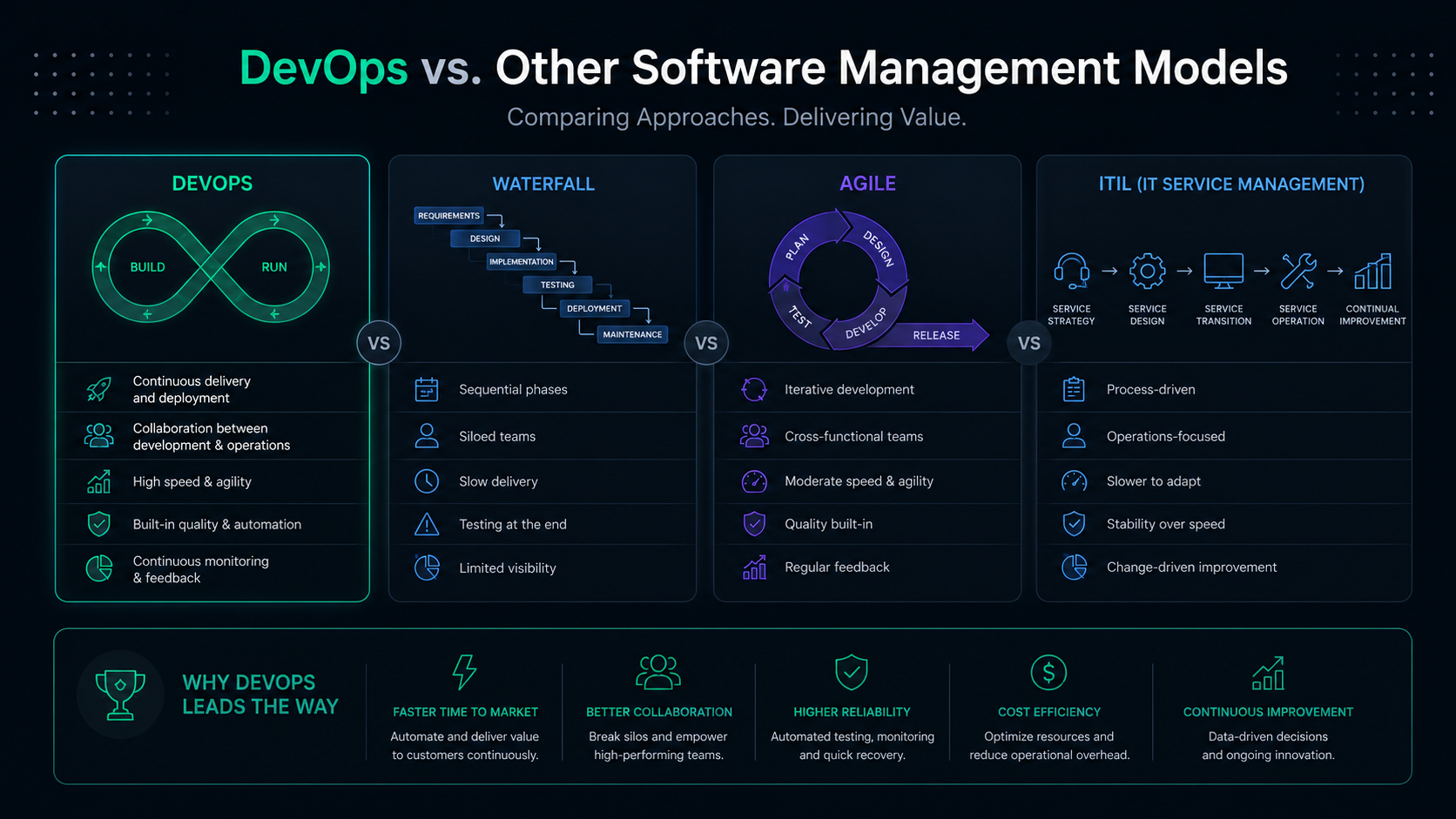
In today’s tech landscape, companies are constantly seeking solutions that not only facilitate software development but also ensure applications are reliable, scalable, and capable of quickly adapting to market demands. Throughout my career as a DevOps engineer, I've had the opportunity to see firsthand how various development models influence software delivery processes. Each methodology, from Waterfall to Agile, brings distinct advantages, yet DevOps has proven to be a powerful approach for integrating and automating the entire software lifecycle, achieving genuine synergy between development and operations teams. This article explores how DevOps compares with other development models and how each approach shapes an organization’s ability to innovate and adapt.
When it comes to software development methodologies, DevOps isn’t the only option on the table. There are traditional models like Waterfall and more modern ones like Agile and Lean, each with its own approach and particular advantages. However, DevOps stands out in several key aspects.
Waterfall
This traditional model follows a linear and strict sequence of phases: analysis, design, implementation, testing, and maintenance. Each phase must be completed before moving to the next, which often causes delays and difficulties in adapting to last-minute changes. DevOps, on the other hand, enables constant iteration and quick response.
Agile
Agile and DevOps share similarities, such as their focus on iteration and quick delivery. However, while Agile aims to improve software development, DevOps includes operations, enabling continuous delivery and deployment. In this sense, DevOps can be seen as an extension of Agile, with added emphasis on collaboration between IT teams.
Lean
Inspired by the manufacturing industry, Lean seeks to optimize processes by eliminating waste. DevOps adopts some Lean practices to improve efficiency but focuses more on automation and integration of the entire development cycle, from creation to production deployment.
In summary, although there are various methodologies for software development, DevOps stands out for its ability to streamline and automate the complete cycle, integrating development and operations to enhance software efficiency and quality.
Why is DevOps Important for Companies?
DevOps has become an essential component for companies looking to stay competitive in a fast-evolving tech environment. In today’s landscape, where adaptability and rapid response are critical, DevOps offers multiple advantages.
- Cost Reduction: By automating processes and optimizing resources, companies can reduce operational costs and maximize team efficiency.
- Greater Customer Satisfaction: The ability to quickly deliver new features and fix issues improves the end-user experience, increasing their satisfaction and loyalty.
- Organizational Resilience: DevOps culture promotes a mindset of continuous improvement, helping companies adapt and refine their processes in response to market needs and technological advances.
- Constant Innovation: Automation and quick feedback loops enable companies to test and implement new ideas faster, fostering innovation and enhancing competitiveness.
For companies aiming not only to survive but thrive in the digital era, DevOps is a powerful tool for achieving business goals more efficiently and effectively.
DevOps Success Stories in Real Companies
Numerous companies have implemented DevOps with impressive results, inspiring other organizations. Here are some success stories:
- Amazon: With its continuous deployment approach, Amazon performs thousands of deployments per day, allowing it to quickly implement new features and continuously improve its platform based on customer needs.
- Netflix: Netflix uses DevOps to manage its cloud infrastructure. Thanks to DevOps, the company can deliver new content, enhance streaming quality, and conduct resilience testing, maintaining high levels of availability and user experience.
- Shopify: Shopify adopted DevOps to streamline its development process and reduce deployment times. By automating their workflows, Shopify can now deploy changes to production in minutes, allowing the company to respond swiftly to customer feedback and market demands.
These cases show how DevOps can transform the way companies operate, driving efficiency, speed, and innovation.
The Future of DevOps
As software development and IT infrastructure continue to evolve, the future of DevOps also promises changes and improvements. Key trends include:
- Increased Use of Artificial Intelligence and Machine Learning (AI/ML): AI will be increasingly integrated into DevOps processes to predict errors, optimize resources, and further automate workflows.
- Advanced Infrastructure as Code (IaC): Infrastructure management through code will continue to evolve, enabling DevOps teams to manage more complex infrastructures efficiently and at scale.
- DevSecOps: This trend involves integrating security into the DevOps process from the beginning, ensuring that security aspects are proactively addressed rather than left for the end of the development cycle.
- Greater Focus on Developer Experience: Organizations will place more emphasis on improving the developer experience, optimizing tools and workflows to facilitate their work and reduce stress.
With these advancing technologies, the impact of DevOps on organizations will continue to grow, transforming not only IT processes but also the way companies create value for their customers.
Conclusion
In today’s tech landscape, companies are constantly seeking solutions that not only facilitate software development but also ensure applications are reliable, scalable, and capable of quickly adapting to market demands. Throughout my career as a DevOps engineer, I've had the opportunity to see firsthand how various development models influence software delivery processes. Each methodology, from Waterfall to Agile, brings distinct advantages, yet DevOps has proven to be a powerful approach for integrating and automating the entire software lifecycle, achieving genuine synergy between development and operations teams. This article explores how DevOps compares with other development models and how each approach shapes an organization’s ability to innovate and adapt.